Building a Portfolio
5 Pillars of Portfolio Construction

Building a portfolio is not a random collection of good ideas. It is a disciplined engineering process. I view portfolio construction through five critical lenses that balance return objectives with structural constraints.

  • 1. Risk Tolerance vs. Risk Capacity

    Distinguish your willingness to take risk (psychological) and your ability to take risk (financial).


    Willingness: Can the you stay the course during a 20% drawdown?


    Capacity: Do you have a secure income stream or high debt levels that limit your ability to absorb losses?

  • 2. The Time Horizon

    Your investment horizon dictates your asset allocation. Capital needed in 12 months (e.g., a home down payment) belongs in "Cash Equivalents," not the equity market.


    The Power of Compounding: A longer horizon allows for a higher allocation to Equities, as time acts as a natural hedge against short-term volatility.


    Your investments should shift from a Growth phase (high equity) to a Preservation phase (high fixed income) as the target date approaches.

  • 3. Tax Efficiency

    In Canada, what you keep is more important than what you earn. Portfolio construction must be integrated with a tax strategy to prevent "leakage."


    Asset Location: As discussed in my [Registered Accounts guide], a 7% return in a TFSA is mathematically superior to an 8% return in a taxable account for many high-earners.

  • 4. Diversification

    Diversification is the practice of combining assets with low correlations. When one asset class is down, another may be up, smoothing the volatility curve of the overall portfolio.


    Geographic & Sector Diversification: A truly diversified portfolio for a Canadian should not just be the big 5 banks. It should include exposure to global tech, emerging markets, and defensives.

Popular Asset Classes

Market Indexes

A market index is a number that tracks the performance of a specific group of securities. For example, the S&P 500 tracks the 500 largest companies in the U.S., while the TSX Composite tracks the headline Canadian market. Investors "buy" an index through an Exchange-Traded Fund (ETF).


Markets are generally efficient over the long term. By using ETFs that track broad indices, you can achieve instant diversification across sectors (Financials, Energy, Tech) at a fraction of the cost of active management.


Some popular ETFs in Canada include

  • VFV (Vanguard S&P 500 Index ETF): The most popular way for Canadians to own companies in the S&P 500. It is "unhedged," meaning you also gain exposure to the USD/CAD exchange rate.
  • VDY (Vanguard FTSE Canadian High Dividend Yield): Heavily weighted toward the "Big Five" banks and major energy infrastructure (utilities/pipelines).
  • XIU (iShares S&P/TSX 60 Index ETF): This ETF tracks the 60 largest, most established companies on the TSX.
  • XEQT (iShares Core Equity ETF Portfolio): 100% Equity. Highly popular for its ultra-low MER (approx. 0.20%) and exposure to over 9,000 global stocks.

Fixed Income

Fixed income refers to investments where the borrower (a government or corporation) is obligated to make payments of a fixed amount on a fixed schedule. This includes Bonds, GICs, and Treasury Bills (T-Bills).


Fixed income is a tool for Volatility Management and capital preservation, in other words it is typically viewed "safer" than equities. Bonds provide a predictable cash flow (coupons) and typically have a low-to-negative correlation with equities during market stress. 

Individual Equities

Equity represents an ownership stake in a corporation. When you buy a share of a company, you are entitled to a portion of its assets and earnings,  what we think of when we say "stocks". Unlike fixed income, there is no guaranteed payment; the return comes from Dividends and Capital Appreciation.


Historically, equities have outperformed all other major asset classes over long horizons. However, equities sit at the bottom of the capital structure. In a liquidation, shareholders are paid last. This makes the stock price highly sensitive to market sentiment, interest rates, and earnings misses. Regulatory changes, management scandals, or technological disruption (e.g., the "AI threat" to legacy software) can destroy a single company’s value even if the broader market is rising.

Other Asset Classes

  • Real Estate

    Real estate is a foundational asset class that provides both capital appreciation and a hedge against inflation.


    REITs vs. Direct Ownership: For most portfolios, Real Estate Investment Trusts (REITs) are the preferred vehicle. They offer institutional-grade exposure (office, industrial, multi-family) with the liquidity of a stock.

  • Private Equity & Private Credit

    This involves investing in companies or debt obligations that are not traded on public exchanges.


    Private Equity (PE): Investing in mature private companies to drive operational improvements before an exit (IPO or sale).


    Private Credit: Acting as the lender to mid-sized companies. As traditional banks (like TD) have tightened lending standards, private credit has become a major source of high-yield, floating-rate income.

  • Cryptocurrency (Digital Assets)

    Cryptocurrency is a digital form of money that uses cryptography for secure, decentralized transactions, operating independently of central banks or governments. 


    It relies on blockchain technology, which is a distributed public ledger that records all transactions across a network of computers. Users can buy, sell, or trade these digital assets as investments, or use them to pay for goods and services.

  • Commodities & Hard Assets

    This includes physical goods like Gold, Oil, Natural Gas, and Agriculture.


    Gold as a Hedge: Historically, Gold has a near-zero correlation with equities, making it the ultimate "Portfolio Insurance" during systemic financial crises.


    Commodities as Inflation Protection: Commodities tend to perform best in the late stages of an economic cycle when raw material prices are surging.

My Personal Portfolio

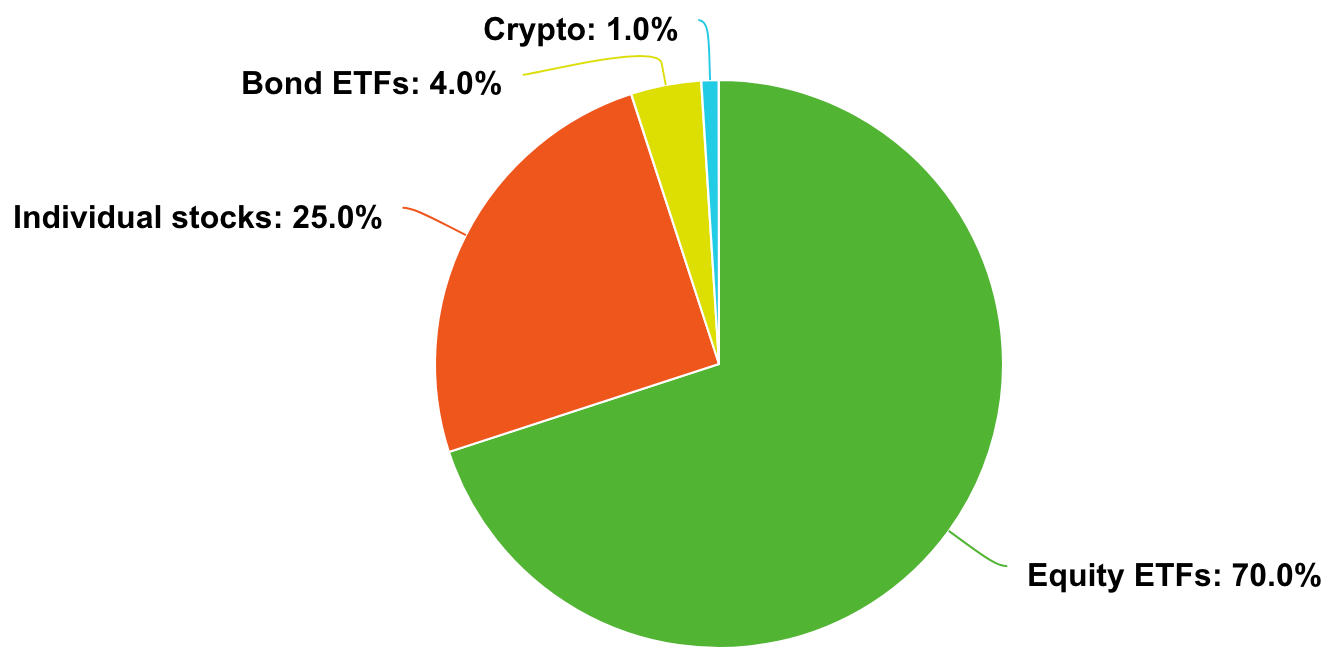
My investment mandate follows a Core-Satellite model. The "Core" of the portfolio consists of 70% North American Equity ETFs, providing low-cost, diversified exposure to the Canadian and US economies. This is stabilized by a 4% allocation to Bond ETFs, acting as a volatility buffer.

Surrounding this core is the "Satellite" component, 25% in Individual equities and a 1% allocation to crypto. I apply fundamental bottom-up analysis to identify undervalued securities and emerging technologies that have the potential to outperform the market